
New York Court Records
New York court records are kept by the Unified Court System, one of the largest in the nation. The state has 62 counties, each with its own set of courts that handle civil, criminal, and family cases. You can search many of these court records online through state portals like WebCivil Supreme and WebCriminal. The County Clerk in each county also maintains case files, judgments, and docket entries that go back decades. Whether you need to look up a pending case, pull a old judgment, or get a certified copy of a court filing, there are several ways to find New York court records from your home or at the courthouse.
New York Court Records Overview
Where to Find New York Court Records
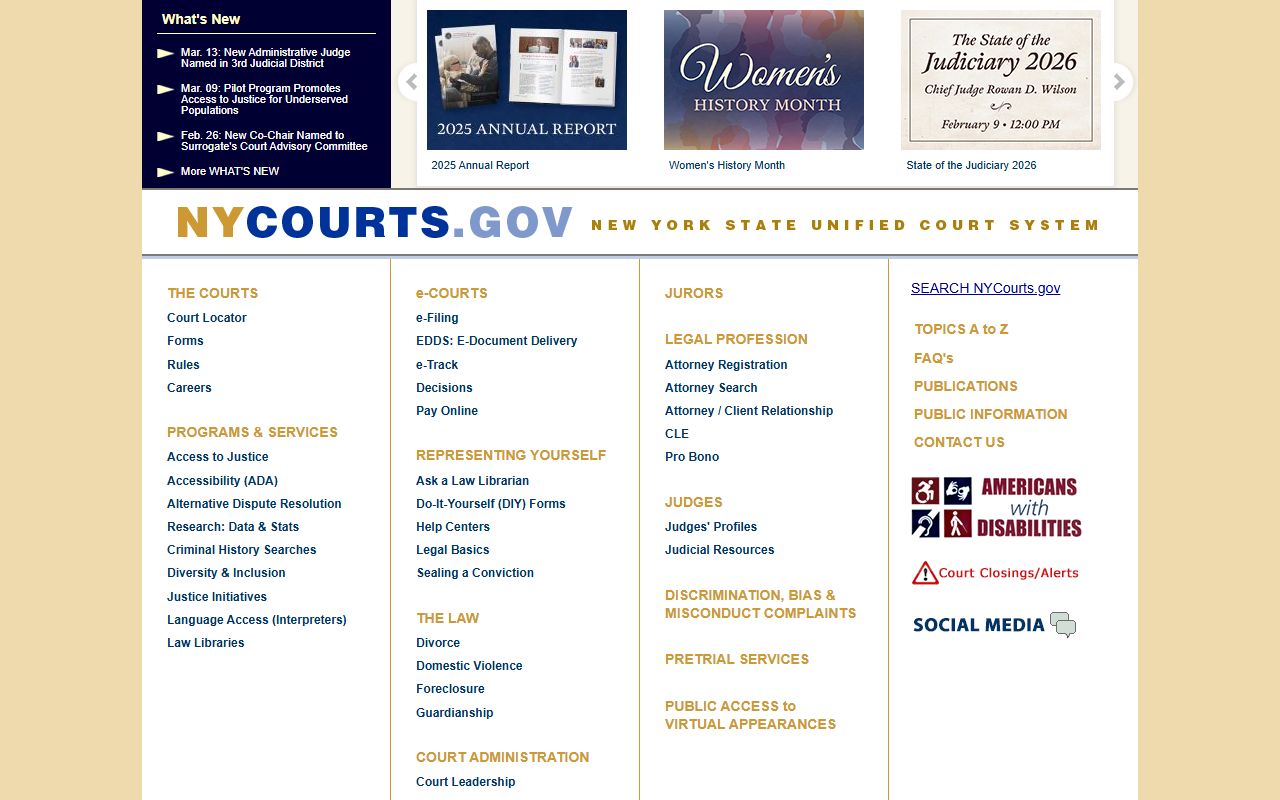
Court records in New York are spread across several court levels. The New York State Unified Court System runs all of them. At the top is the Court of Appeals, the state's highest court. Below that sit four Appellate Divisions. Then you have the trial courts: Supreme Court, County Court, Family Court, Surrogate's Court, Court of Claims, and various local courts like City, Town, and Village Courts. Each one creates and stores its own records.
The Supreme Court is the main trial court. It handles civil cases over $25,000, felony criminal matters, and divorce proceedings. Do not let the name confuse you. In New York, "Supreme Court" is not the highest court. It is the trial level. Every county has a Supreme Court, and the County Clerk in that county keeps the case files. You can search Supreme Court civil cases through the WebCivil Supreme portal by index number, party name, or attorney name.
County Court deals with felony criminal cases and civil matters up to $25,000. Family Court handles custody, child support, paternity, and juvenile cases. Surrogate's Court covers wills, estates, and guardianships. Each court type keeps its own set of records, and access rules can differ depending on the case type and court level.
Note: Matrimonial case files in New York Supreme Court are confidential under Domestic Relations Law. Only the parties and their attorneys can view those files. Other court records are generally open to the public.
How to Search Court Records in New York
New York gives you several free online tools for court records. Each one covers a different part of the system.
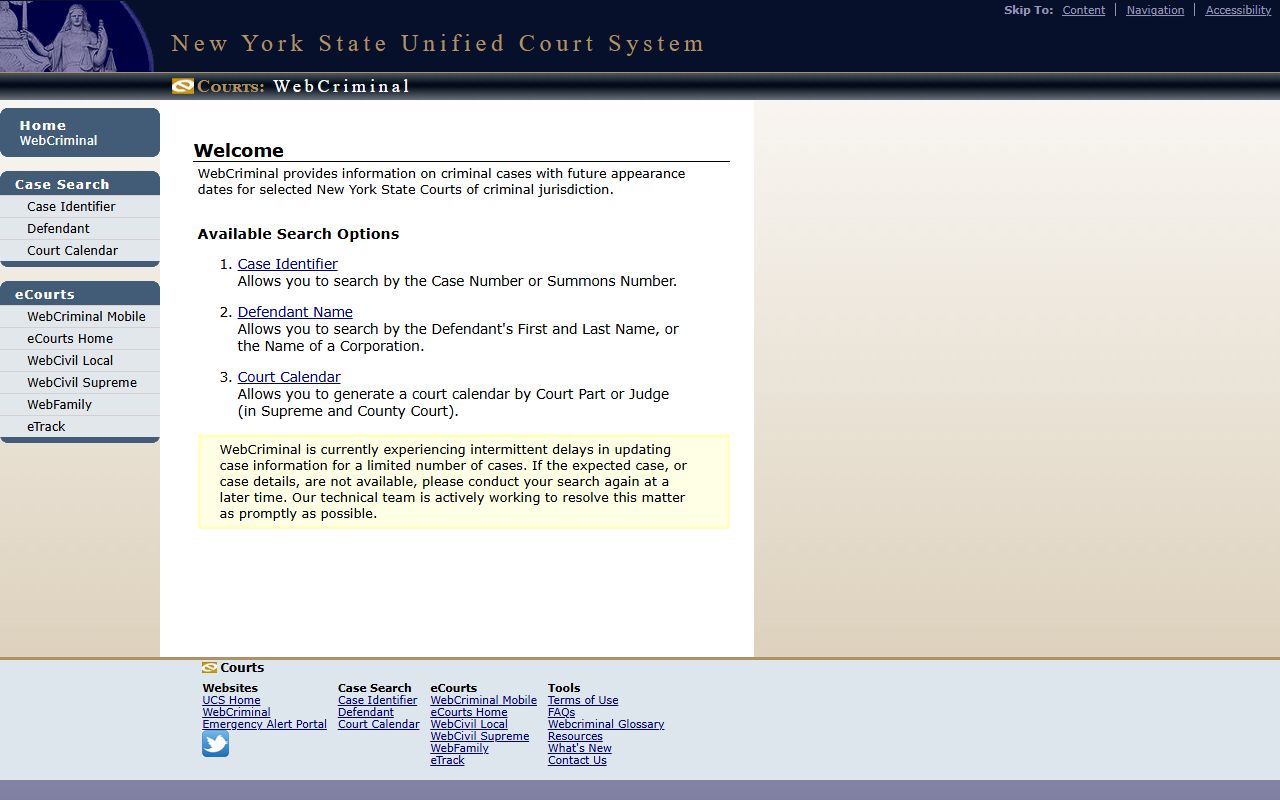
WebCriminal lets you look up pending criminal cases with future court dates. It covers NYC Criminal Courts in all five boroughs, plus Nassau and Suffolk County District Courts, County Courts in the 9th Judicial District, and Erie County Court. You can search by case number, defendant name, or court calendar. The system is free and open to the public. It does not include sealed cases or cases that have no future court dates.
WebCivil Supreme covers civil cases in Supreme Court statewide. Search by index number, party name, or attorney name. Cases show up after a Request for Judicial Intervention has been filed. The portal shows case status, judge assignment, and court dates. For cases filed through NYSCEF, you can also view the actual documents online.
The New York State Courts Electronic Filing System (NYSCEF) stores documents for e-filed cases. Once you have a case index number, you can pull up motions, orders, and filings. E-filing is mandatory for attorneys in many Supreme Court case types. Self-represented litigants can also use the system.
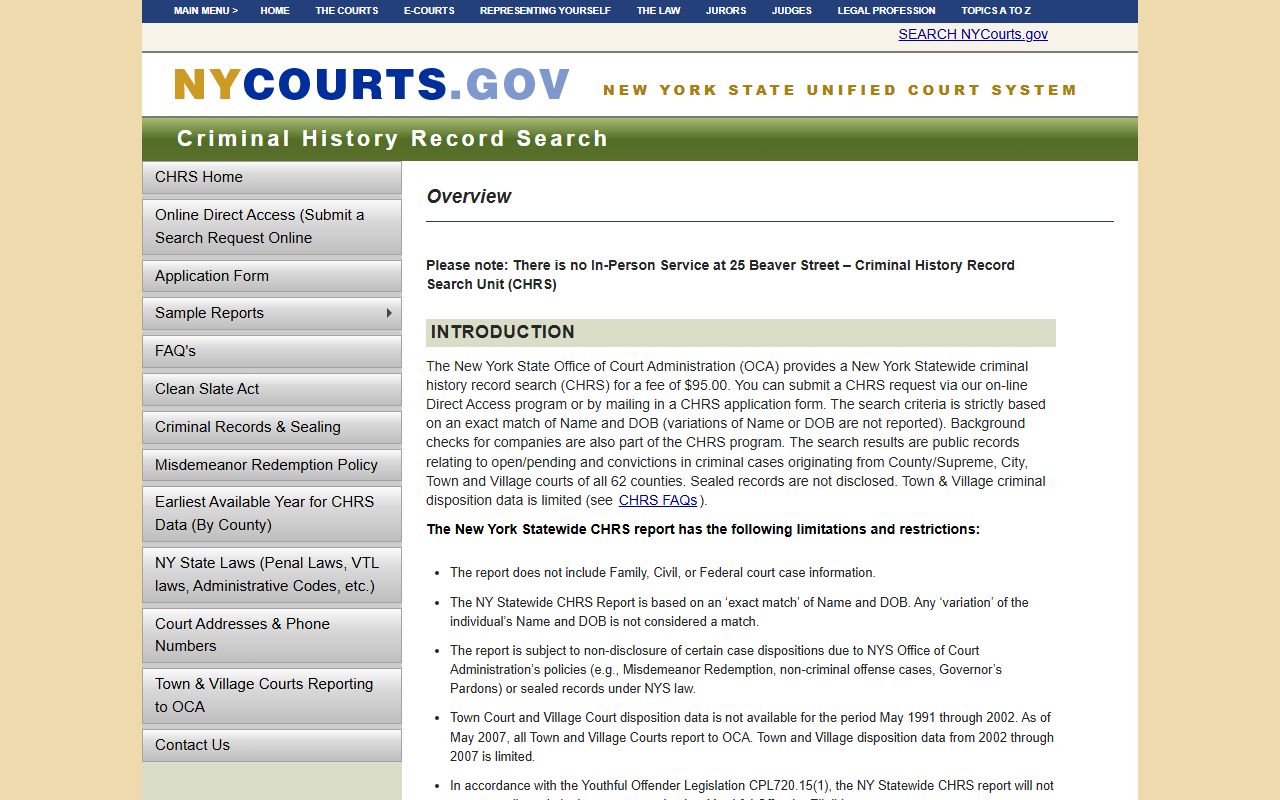
For a broader criminal history search, the Office of Court Administration Criminal History Record Search (CHRS) checks all 62 counties. The fee is $95 per name and date of birth search. Results come back by email the next business day for online requests. This is a name-based search, not fingerprint-based. It covers open criminal cases and convictions but not sealed records or youthful offender adjudications.
Types of New York Court Records
The range of court records in New York is broad. Criminal records include indictments, arraignment minutes, plea agreements, trial transcripts, and sentencing orders. Civil records cover complaints, answers, motions, discovery documents, and final judgments. Family court records include custody petitions, support orders, and juvenile delinquency files (though most family court records have restricted access).
Surrogate's Court files hold probate petitions, wills, estate accountings, and guardianship papers. Most probate records are public. Court of Claims records deal with lawsuits against the state. Small claims records from City, Town, and Village Courts cover disputes under certain dollar amounts.
Under Judiciary Law Section 255, court clerks must maintain accurate records of all proceedings and make them available for public inspection, with certain exceptions. Certified copies are available from the County Clerk's office for a fee. Standard copies run $0.65 per page with a $1.50 minimum. Certification adds $5.00 per document in most counties.
Court Records Access and Privacy in New York
New York court records are presumed open to the public. You do not need to be a party to the case. You do not need to give a reason. Walk into any County Clerk's office during business hours and ask to see a file. That said, some records are sealed or restricted by law.
Criminal records can be sealed under Criminal Procedure Law Section 160.50 when a case ends in favor of the accused. Dismissed cases, acquittals, and certain declined prosecutions get sealed automatically. The records come off public databases. Law enforcement still has access, but the public does not. CPL 160.55 covers sealing of violation and traffic infraction convictions. CPL 160.59 allows sealing of some older convictions after 10 years under the Clean Slate Act.
Family Court records are largely confidential. Juvenile delinquency and PINS cases are sealed. Child custody and support files are restricted to the parties involved. Matrimonial files in Supreme Court are also confidential.
If you believe records have been wrongfully withheld, CPLR Article 78 provides a way to challenge the denial in court. You file a special proceeding in Supreme Court within four months of the denial. The burden falls on the agency to justify keeping the records closed.
Criminal History Court Records in New York
The Division of Criminal Justice Services (DCJS) maintains the state's official criminal history records, also called rap sheets. These are fingerprint-based and include arrest, indictment, conviction, and sentence data reported by police, prosecutors, and courts across New York.
If you want to review your own record, you go through DCJS. The process requires fingerprinting at an IdentoGo location. The fee is $14.25 for New York residents and $44.25 for out-of-state residents. Processing takes 3 to 4 weeks. Results are mailed to you. Fee waivers are available for qualifying individuals. You can reach DCJS at RecordReview@dcjs.ny.gov or call 518-457-9847.
The DOCCS Inmate Lookup is a separate tool for checking on people in state prison. It shows current facility, sentence details, and parole eligibility. It does not cover county jail inmates or federal prisoners. The search is free.
How to Request Court Records in New York
For court case records, you go straight to the court clerk where the case was filed. FOIL (Freedom of Information Law) does not cover court records directly. Courts are excluded from FOIL. Instead, court records fall under Judiciary Law. The Committee on Open Government confirms this distinction.
FOIL does apply to the Office of Court Administration for administrative records (not case files). You can submit a FOIL request by email to foil@nycourts.gov or by mail to the OCA FOIL Officer at 25 Beaver Street, Room 830, New York, NY 10004. Standard copy fees under FOIL are $0.25 per page. The agency has 5 business days to respond.
For court case records, contact the County Clerk. Most offices accept in-person requests during business hours. Some accept mail requests with a check or money order for fees. A few counties offer online search through IQS or similar platforms. The NYS Court Forms Repository has standardized forms for all court types if you need to file a new case or respond to one.
New York Court Records at the Appellate Level
The CourtPass portal gives public access to Court of Appeals case information. You can search by party name, decision date, or authoring judge. The Court of Appeals sits in Albany and hears cases from the four Appellate Divisions. Its decisions are binding on every lower court in the state.
Appellate Division records are available through the respective departments. Each department covers a geographic region. Briefs, motions, and decisions are part of the appellate court record. Oral arguments at the Court of Appeals are open to the public and sometimes livestreamed. Published decisions set the precedent that shapes how all New York court records are handled going forward.
Filing Complaints and Court Records Oversight
The Commission on Judicial Conduct investigates complaints about judge behavior. It covers all New York State judges. Complaint forms are available online and can be filed anonymously. The Commission can admonish, censure, or remove judges for misconduct. Their determinations are public and searchable on their website. Contact them at 61 Broadway, 6th Floor, New York, NY 10006, or call (212) 809-0566. The Commission does not handle case appeals or disagreements with court decisions.
Browse New York Court Records by County
Each of New York's 62 counties has a County Clerk who keeps Supreme Court and County Court records. Pick a county below to find local contact info and resources for court records in that area.
Court Records in Major New York Cities
Residents of major cities file court cases at the courts in their county. Pick a city below to find out where to go for court records in that area.